
Take action
Do you watch or read climate crisis news and think: "Ok, this is bad, but what now? What can I do about this?"
We do too. Even this website, as it alerts you to the destructive cycle that our money is stuck in, might be making you feel overwhelmed and powerless.
Well, no more! It's time to take action:
Apply pressure
It has been proved over and over again that people power creates change. Some would say it’s the only thing that creates change. So, whatever your personal banking situation and intentions are, this is your guide to applying your unique brand of pressure to the industry.
If you take only one action while visiting our site today, we hope it will be to sign the Bank.Green pledge to move your money away from fossil banks:
Even if you are still tied into a financial product with your current bank, your pledge is what matters. Every name we gather represents another person who is prepared to claw their money back from the fossil fuel industry. The longer this list grows, the more powerful we become - and the harder we'll be to ignore.
If you're not ready to move your money now or in the future, or if you already bank sustainably, the very best way to turn up the heat up on the banks is to let them know your concerns:
Start a conversation with a fossil bank
Start a conversation? That doesn't exactly sound action-packed. What's that going to achieve?
Well, we think this action is vital. If enough customers, or potential customers, make it clear that they are unhappy and alarmed by a bank's financing of fossil fuels, the bank will feel the pressure to either change, or face losing customers. The more conversations, the more pressure.
There are a few ways you can start such a conversation. Before you get in touch, we encourage you to check how the bank ranks for fossil fuel financing. If you mention this information when you talk to the bank, it will be difficult for them to change the subject.
Calling your bank is one of the most powerful things you can do. It’s direct, personal, and difficult for them to ignore. Most banks receive very few climate-related calls, so yours will stand out — and could spark internal discussions at surprisingly high levels.
If your bank hasn’t been rated yet, or you want to put extra pressure on them to improve, this is the best way to do it.
Before You Call
- Where to start: Try the investor relations department if you can find the number on the bank’s website. Otherwise, the main customer service line is fine.
- When to call: Early or late in the day helps you avoid long hold times.
- Be ready: Jot down a few notes so you feel relaxed. Nerves are normal — they show you’re genuine.
- Ask for your call to be logged: Before hanging up, say “Could you please log my call for follow-up and pass it to your sustainability or investor relations team?”
What to Say
You can open the conversation with something simple like:
“I’ve become aware that [bank name] is financing fossil fuel companies and projects. I don’t think customers’ money should be used in ways that are incompatible with a sustainable future. Can I please talk to someone about this?”
If they ask you to email instead, agree — but make sure the call is logged first.
Key Questions to Ask
Once you’re through to someone who can help, these questions will tell you a lot about where your bank stands:
- Fossil fuel financing: “What percentage of your commercial lending supports fossil fuel industries such as exploration, extraction or distribution?”
- Renewable energy support: “What percentage of your lending goes to renewable energy projects or development?”
- Exclusion policies: “Do you have any policies that explicitly rule out financing for fossil fuel companies? Are these public?”
If You Want to Go Further
If you’d like to probe deeper, you can also ask:
- “Do you measure your financed (Scope 3) emissions?”
- “Have you set science-based, independently verified emissions-reduction targets?”
- “Do you offer any green financial products, like loans for solar panels or EVs?”
If You’re Not Satisfied
If the bank avoids answering or gives vague replies:
- Ask to escalate to the sustainability or investor relations team.
- Submit a formal complaint so it’s recorded.
- Switch to a climate-friendly bank — and tell your current bank why you’re leaving.
- Share your experience with friends, social media, or us at Bank.Green to help others take action.
[Explore climate-friendly banks →]
Why It Matters
Every call adds pressure. When enough customers ask these questions, banks notice — and change follows. One call can start a ripple effect.
We do urge you to try calling first, for the biggest impact. If you don't feel comfortable doing that, however, then writing an email or a letter is still a great step you can take.
This template has been created to inspire you, but please write something in your words, with specific information about the bank you are addressing. Original emails or letters can make a bigger impact. Companies quickly develop automation strategies to deal with waves of templated emails or letters, but these strategies cannot be applied to unique ones. This means that personalizing your message will make handling and responding to it more time-consuming for the bank, so you'll make a bigger impact.
If it is your own bank you are addressing, you should of course customize it as such, and can also verbiage about being prepared to move your money out, if indeed you are.
Dear XXX,
I am writing to you because I am increasingly concerned about your investment decisions and what this means for your customers' money.
I have recently discovered that your engagement with the fossil fuels industry continues, with nothing to suggest that you are making sufficient changes to align with a sustainable planet. It is now extremely clear that the extraction and burning of fossil fuels is heating our planet. If this activity is not halted, our futures will become increasingly unstable. I am sure you can appreciate that I would not want mine or anyone else's personal funds to be contributing to such a future.
Furthermore, supporting an industry with declining prospects does not seem economically viable.
This activity leads me to question your decision-making, as well as your regard for me as a customer/potential customer.
I would like to know if you plan to stop enabling the extraction and burning of fossil fuels. If you do intend to stop, please lay out your plan and the timeline to me.
I look forward to hearing from you soon.
Yours sincerely,
XXX
If you prefer in-person communication, you could book an appointment with the manager at your local bank branch. Face-to-face is often the most engaging and rewarding method of interaction we have, so starting a conversation with a fossil bank in this way is particularly powerful.
Switch your bank
It's not fun to realize your bank is lending billions to projects that are accelerating the climate crisis. People with the conviction to remove their funds from these banks have the collective power to force the industry to rethink its actions.
If you’re ready to join this movement and transfer your money somewhere better, this section will help you do so as easily as possible. The first step is to decide where to move your money to:
Already found your new bank? We've got you covered. In the guide below, we walk you through the 5 easy steps for moving your money to a new, planet-friendly bank account, in a way that makes your old bank sit up and take notice. It's likely going to be a lot faster than you think!
- This process varies by bank, but a large proportion of banks now allow you to open an account from their website, often in as little as 10 minutes.
- Whether you open an account online or by visiting a branch, you should have on hand two forms of identification.
- First, identify the automatic deposits (such as your salary) and debits (such as monthly subscriptions) that are present on your existing account.
- Many banks now perform these transfers for you, so ask your current and new banks whether they can help with them. If not, you will need to set these up again manually with your new bank.
- You will need to pay off any credit card or other debts associated with your old account before you can close it. Make a plan for doing this.
- In cases where you might hold other financial products with your bank, speak with your representative about how closing your account might affect them and make a plan to address this.
- Before doing this, make sure you have double-checked that all automatic payments have been transferred across and that you have no outstanding payments or checks that haven't cleared yet.
- Once confirmed, you can transfer your funds over. Doing this electronically is fastest and usually preferable to doing it with a check.
- Call or email your old bank's customer service department and ask for them to close your account. Ask to receive written confirmation of the closure, by email or letter, so you can be sure your account was actually closed.
- Switching to a bank that doesn't finance fossil fuels is a hugely important climate action in and of itself. But the action can be amplified greatly by letting your old bank know why you are leaving them. After all, if you move your money but don't tell your old bank why, they won't feel any pressure to change.
If you choose to do this while on the phone with your bank's customer service, be sure to ask them to log your concern along with the closure. For maximum impact, however, we suggest also asking them for the appropriate email address to write to, then sending a customized version of the below template:
Dear XXX,
I recently closed my [bank name] accounts and I would like to explain why.
While I was your customer, I became increasingly concerned over your continued engagement with the fossil fuels industry. Thousands of scientists from around the world have said that if we continue to heat Earth's atmosphere by burning fossil fuels, it will become increasingly difficult to live on this planet. I do not want my money to enable such a future, so I decided to put it elsewhere.
My wish is for my actions and this letter to make [bank name] urgently reconsider its activities. If [bank name] invests for the good of our environment, it will in turn be investing in its customers, not to mention its business.
I hope that it doesn't take many more messages like mine for [bank name] to stop investing in environmentally destructive activities, such as the extraction and burning of fossil fuels. These decisions are no longer morally responsible or financially viable.
I look forward to hearing from you on this matter.
Yours sincerely, XXXX
Account number: XXXXXXXX
Lastly, letting your new bank or credit union know why you are joining them will encourage them to speak up more about the impact of fossil fuel finance. It will also put further pressure on the fossil banks to reform.
Once you've performed all of the above steps, treat yourself to something amazing, because you've just done something amazing!
Please report back to us on how the move went and how much money you moved. If you do, it will allow us to help even more people to take the same action, while making an even bigger noise against the fossil banks.
Almost there! To add the most value to your powerful climate action, you should let your friends and family know about your switch, which may encourage them to do the same. Head over to the next tab for tips on how to do just that.
Share the message
Every effective mass movement is a numbers game, so let's give the fossil banks some figures that they won't enjoy analyzing: increasing the percentages of customers calling them out. To pull this off, we need you to advocate, advocate, advocate. Find out how to help swell our movement here.
Talk to your friends, family, and followers
Bank.Green knows that listening to a concerned individual who you care about is more powerful than listening to the messaging of a campaign group. That's why encouraging people to talk to their own banks is at the core of this movement.
The same can be applied to personal relationships. Your friends, family, and social media circle will listen to you much more carefully than they will listen to us.
- Nobody enjoys being told what to do and it doesn't work anyway. You'll probably both end up feeling annoyed.
- All you can do is explain your feelings and decisions, then answer any questions.
- Everybody has their own motivations, especially when it comes to money.
- Guilt is not an effective motivating emotion.
- If you deliver your opinions in a neutral, open way, you'll probably discover that your message will slowly get through in the following weeks or months.
- Don't focus on how terrible or morally corrupt banks are. We are all a part of this system, we are all somehow implicated in the destruction of our environment.
- Instead, focus on the good that socially responsible banks can achieve, or how our world would be if more of our money was invested in improving the environment.
- Recent history has shown us that creating sides and pushing the blame on "the others" does not get results.
- Try to find common ground, whether it be with your friends and family, or with your bank.
- Explain the personal journey you have been on with the issues that Bank.Green raises.
- We all respond to stories, because they help us to make sense of the world we live in.
- Many think that switching bank accounts is difficult, messy, and that we might somehow lose money.
- Just like most other administrative tasks, it may take a few hours and you will need to make a few decisions.
- In comparison to, for example, switching to a plant-based diet, or lobbying your local politician to prioritize the environment, changing your bank account is less work and has a smaller impact on your day-to-day life.
- Try to forget about your agenda, or how you're going to win the argument.
- If you concentrate on listening, the quality of your conversation will improve, and you'll have a better understanding of where your friend or family member is coming from, which will probably lead to better outcomes.
Post on social media
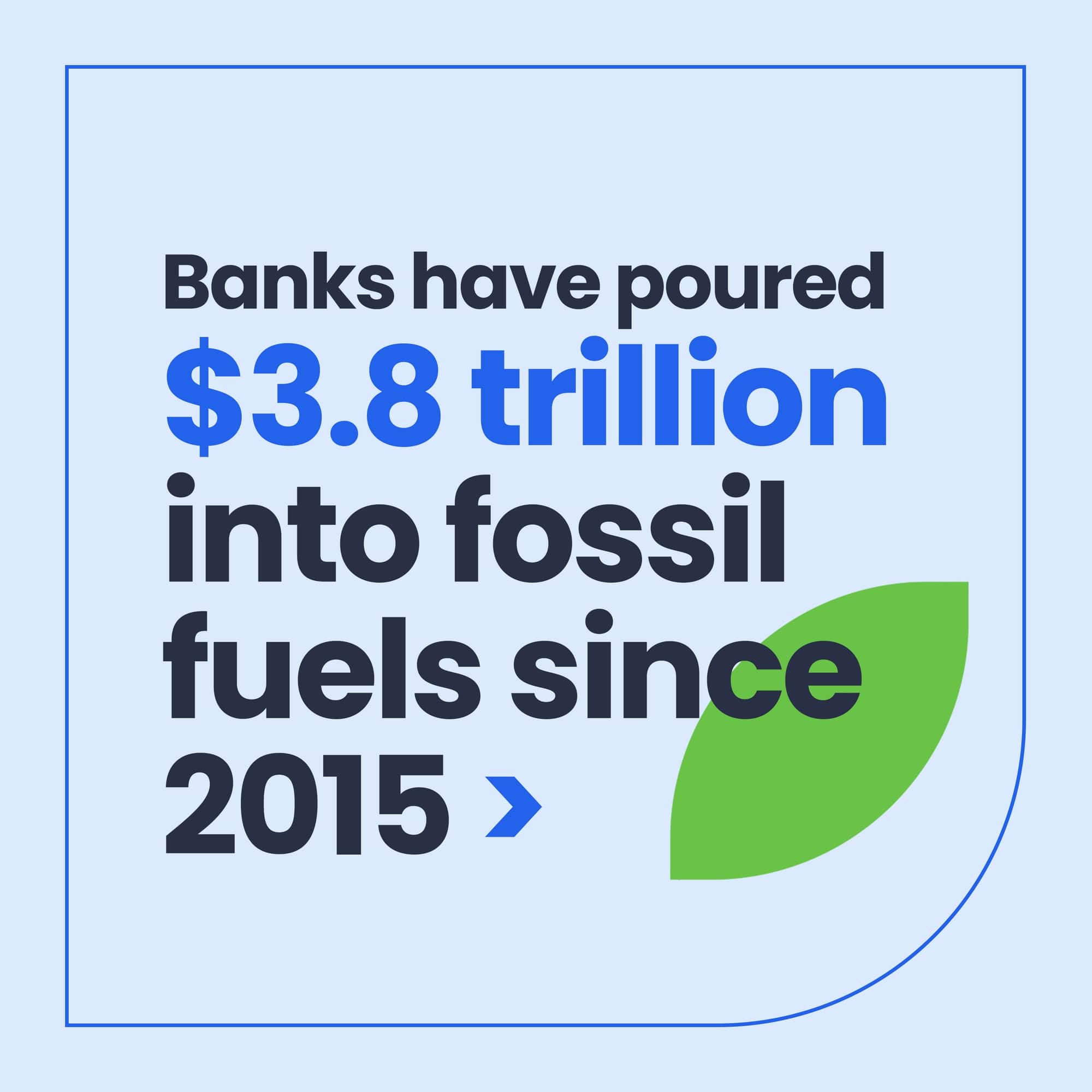
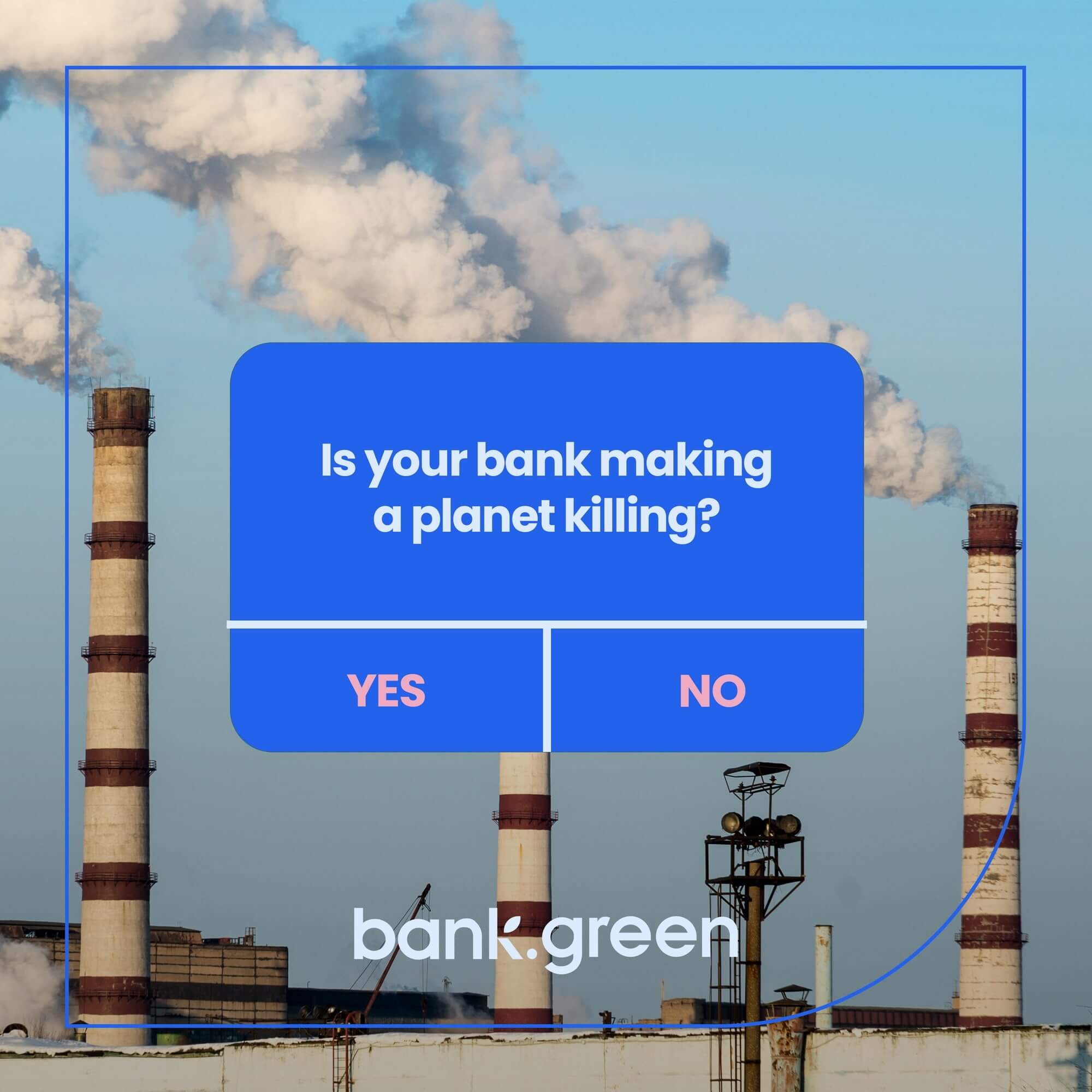
Lastly, we've prepared images below that you can right-click and save to share with your followers:

Learn more
Knowledge is power. That's why the fossil fuels industry has been consulting with climate scientists for more than 60 years. This is the section where you can get clued-in on the news and issues surrounding the banking industry, fossil fuels, and the climate crisis.
The Bank.Green blog
Browse a mixture of deep-dive, long-read pieces and shorter updates on the spaces where the fossil fuels industry, our banks, and the climate crisis intersect.
Reading list
Global Warming of 1.5ºC, IPPC
This report by the Intergovernmental Panel on Climate Change (IPPC) sets out the case for why we should not exceed 1.5°C of global heating. It's the scientific basis for all of our efforts.
Money Is The Fire On Which The Oxygen Of Global Warming Burns, The New Yorker
A comprehensive overview of fossil finance and the threat it poses to our future by the environmentalist and founder of 350.org, Bill McKibben.
Banking on Climate Chaos, 2023
The annual report with the most up to date information about banks' financing of fossil fuels, on which we base the majority of our ratings of fossil banks.
Watch list
Taking Action Against Against Fossil Finance
Our first webinar, featuring speakers from our expert partners, Reclaim Finance and BankTrack:
'End Fossil Finance' Panel
An excellent panel discussion featuring Bill McKibben, founder of 350.org, on the various ways we can put an end to fossil fuel finance.