
Three years. £33.2 million moved. 9,322 tonnes of CO2e averted per year. And this is only the tip of the iceberg.
Updated June 8, 2026 by Cemile Marsan

Bank.Green’s mission is to expose how the global banking system continues to fuel the climate crisis by financing fossil fuel extraction. Our platform provides a streamlined way for customers to see how their money is being used and, more importantly, how to move it. By assessing how banks contribute to environmental harm, our rating system empowers individuals and organisations to align their finances with their values. Knowing which banks are harmful is foundational. The next step is measuring what happens when people act on that knowledge.
Bank.Green's Impact Team bridges the gap between individual action and measurable impact. Using the data from our Switch Survey, we aim to answer the important question: “How many tonnes of CO2e emissions were avoided as a consequence of the collective movement of funds away from fossil-fuel-funding banks?”
The Challenge Of Measuring Bank Switching Impact
While adding up the reported sum of moved funds is straightforward, translating that capital into "avoided emissions" is a more complex puzzle. It requires a deep dive into financed emissions, classified under Scope 3, Category 15 of the Greenhouse Gas (GHG) Emissions Protocol. For an overview of how companies and other organisations classify their GHG emissions, see this explainer. Financed emissions refer to GHG emissions that are produced as a result of a company’s financial investments. For a bank, this is the carbon footprint that it enables through its lending and investment portfolio. For a primer on this, see our blog post: Why Banks Must Decarbonize.
To understand a bank’s true impact, we have to look past the marketing and into its annual disclosures. However, not all reports are created equal. Here is what you need to know about the current "Carbon Blind Spot":
- For financial institutions, Financed Emissions (Scope 3, Category 15) typically represent over 95% of their total carbon footprint. Hence, a bank that boasts about "mandatory Scope 1 and 2 compliance" while ignoring Scope 3 is essentially not reporting its true climate impact.
- Scope 3 reporting requirements vary significantly, depending on where a bank operates, with no uniform global standard in place. While the EU leads with non-negotiable disclosures under the Corporate Sustainability Reporting Directive (CSRD), the picture elsewhere is murkier. In the US, the SEC rolled back climate rules in 2025, leaving no federal mandate. Similarly, banks in Canada are not required to report Scope 3 until 2028, and the UK's new Sustainability Reporting Standards, while a step forward, still allows banks to report on a 'comply or explain' basis until 2027-2028.
Because of these regulatory gaps, self-reported emissions from banks based outside the EU should be taken with a grain of salt until at least 2027. Currently, a bank’s lack of thoroughness in reporting Scope 3 emissions is rewarded: incomplete measurements make a portfolio appear 'cleaner' than it is. This is greenwashing by omission. Radical transparency in financed emissions is the only way to close this loophole. Until stringent Scope 3 disclosure standards are in place and enforced, the true climate impact of the global banking sector will remain conveniently hidden.
Measuring the Switch
Bank.Green's Switch Survey collects data from website users who have switched to more sustainable banks, capturing which banks they switched from and to, and how much money they moved in the process. Since the beginning of 2023, the Switch Survey has collected 2270 responses, of which 1380 included completed bank switches with reported amounts. Taken together, these respondents moved a combined £33.2 million away from fossil-fuel-funding banks toward greener alternatives. The survey’s reach is strongly concentrated in the UK and North America (92% of completed responses): UK respondents account for 717 entries with just over £14.7 million moved, while users in the USA and Canada together contributed 555 entries and nearly $19.7 million USD in switched funds. EU respondents make up a smaller but meaningful share, with 84 entries and nearly €2.2 million moved.
To quantify the impact of the bank switchers, we use a data-driven approach based on a banks' portfolio-level emissions intensity. We continuously review publicly available sustainability reports and annual financial reports to identify GHG emissions associated with a bank’s financing activities. To translate these massive figures into a metric that is both meaningful for consumers and comparable between institutions, we define a bank’s “emissions intensity,” meaning the amount of emitted and financed GHG emissions (measured in tons of CO2e) per invested dollar (or other local currency). This “carbon footprint per invested dollar” is calculated by comparing a bank’s disclosed financed emissions to its total outstanding loans and advances.
It is important to note that this approach does not assume that an individual’s deposits are directly allocated to specific fossil fuel projects. Instead, it provides a vital portfolio-level indicator of how carbon-intensive a bank’s financing activities are relative to its overall capital. When users engage with our website and report switching banks or reallocating deposits through the Bank.Green Switch Survey, we combine those specific dollar amounts with banks’ “emissions-per-pound” intensity metrics to estimate the emissions exposure linked to those funds.
For bank switchers in the USA, reliable emissions intensity data is difficult to obtain given the absence of federal Scope 3 reporting mandates. We therefore rely on emissions intensity averages from Project Drawdown's report Saving (for) the Planet, which estimates 0.24 tCO2e per $1,000 per year for fossil-fuel-funding banks and 0.057 tCO2e per $1,000 per year for green banks. It is worth noting that these figures are likely conservative: US banks have continued to increase their fossil fuel financing since the report was published in 2023, meaning the true emissions intensity of fossil-fuel-funding banks is probably higher than what our analysis currently reflects.
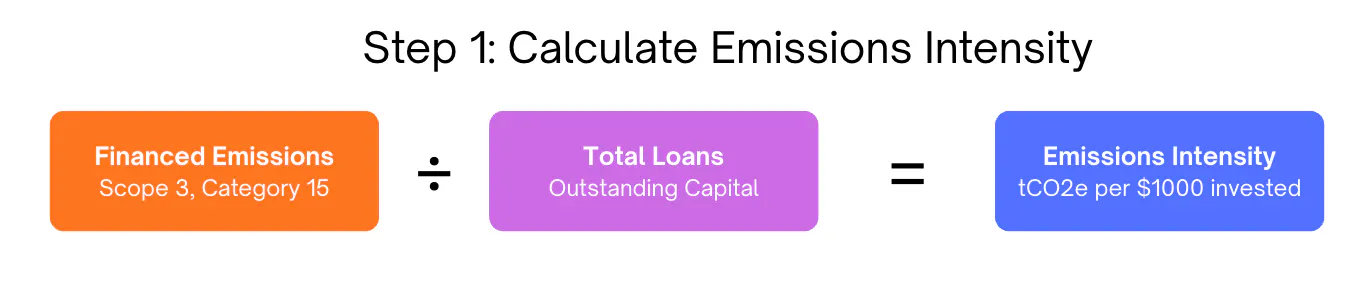
For UK bank switchers, we calculate emissions intensities directly from banks' publicly available annual and sustainability reports. Our analysis shows that fossil-fuel-funding UK banks typically fall within the range of 0.14 to 0.35 tCO2e per $1,000. In contrast, sustainable alternatives maintain a significantly lower profile, with intensities ranging from just 0.006 to 0.02 tCO2e per $1,000. However, for some of the most carbon-intensive institutions, the resulting figures can appear suspiciously low. This is not surprising given the current regulatory landscape: the “comply or explain” loophole makes it relatively easy for banks to underreport by simply not looking too hard. As a general principle, the fewer investments that are scrutinised, the lower the reported emissions will be. Our UK intensity figures should therefore be understood as floor estimates rather than true reflections of a bank's carbon footprint.
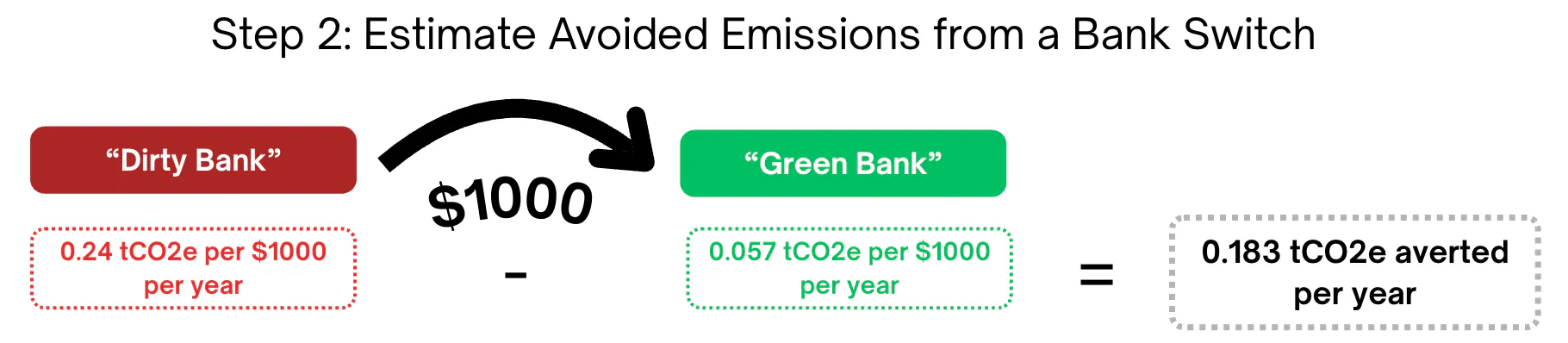
For instance, if a fossil fuel funding bank has an emissions intensity of 0.24 tCO2e per $1,000 per year invested, and a user moves $1000 away from it to a green bank with an intensity of 0.057 tCO2e per $1000 per year, we estimate that this results in 0.183 metric tons CO2e per year in avoided emissions exposure. This is equivalent to roughly 1000 km driven by an average gasoline-powered passenger vehicle based on data from the Carbon Trust and the UK government’s 2025 conversion factors.
Based on the responses captured in the Switch Survey, the collective impact of these individual actions is substantial. By moving their funds to more sustainable financial institutions, our community is averting an estimated 9,322 metric tonnes of CO2e per year – an amount equivalent to the carbon sequestered by nearly 373,000 trees annually. This impact is even more striking when viewed through a regional lens. In the UK, the collective shift away from high-carbon banking is equivalent to removing 1,926 internal combustion vehicles from the road annually. Similarly, switchers across North America have achieved a significant milestone by effectively taking 914 passenger cars off the road every year. This represents a tangible shift in financial power, redirecting capital away from the drivers of climate change toward the solutions we need.
It is important to note that these calculations are based only on the users who chose to fill out the Bank.Green’s switch survey, which is only a small fraction of the bank switches that Bank.Green enables. Thus, the reported values are a conservative, directional estimate of the carbon footprint users are moving away from or toward through their financial choices.
Every switch you report helps us build a more complete picture of how individual financial choices add up to real climate impact.
Start to Bank Green Today
- Send a message to your bank that it must defund fossil fuels
- Join a fast-growing movement of consumers standing up for their future
- Take a critical climate action with profound effects